How Many Weeks Is Ny Family Paid Leave
Spring to a section of this report:



 A growing share of working parents and an aging population accept put pressure on more American workers as they balance family unit caregiving responsibilities and work obligations. Amid these changes, the consequence of paid family and medical leave has captured the attention of policymakers and advocates beyond the political and ideological spectrum.
A new study conducted past Pew Inquiry Center finds that Americans largely back up paid leave, and most supporters say employers, rather than the federal or state government, should cover the costs. Yet, the public is sharply divided over whether the authorities should require employers to provide this do good or let employers make up one's mind for themselves, and relatively few see expanding paid leave as a top policy priority.
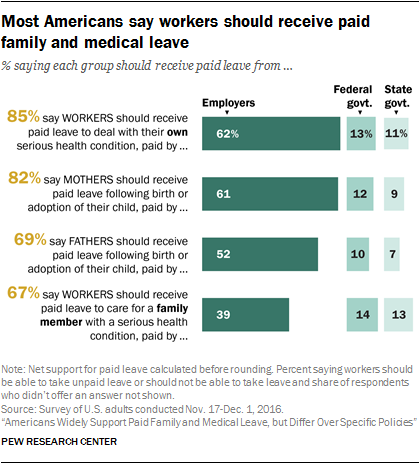
While majorities of adults express back up for paid leave for mothers and fathers after the nativity or adoption of their kid, as well as for workers who need to intendance for a family unit fellow member with a serious health condition or to bargain with their own medical issues, support is greater in some cases than in others. Nearly eight-in-ten Americans (82%) say mothers should have paid motherhood leave, while fewer (69%) back up paid paternity exit. And those who favor paid maternity and paternity leave say mothers should receive considerably more than time off than fathers (a median of 8.6 weeks off for mothers vs. 4.3 weeks for fathers).
 At that place is also broader support for paid leave for workers dealing with their own serious health condition (85% say workers should exist paid in these situations) than there is for those caring for a family unit member who is seriously ill (67% favor paid go out for these workers).
The wide-ranging report of public attitudes about paid family and medical get out besides included nearly six,000 interviews with Americans who have recently taken leave (or were unable to take leave when they needed or wanted to practice so), in order to reflect direct personal experiences likewise equally policy views. The survey finds that 64% of those who took leave in the past two years say they received at to the lowest degree some pay during their time off. A big majority of them (79%) say that some or office of that pay came from holiday days, sick leave or paid time off (PTO) they had accrued prior to their get out. Only xx% of those who got paid – or 13% of all "leave takers" – say they had access to family unit and medical leave benefits paid past their employer.
Note on terminology
Throughout this written report, when referring to attitudes toward paid leave policies, the terms "family unit and medical get out" or get out from work for "family or medical reasons" refer to time off following the nativity or adoption of i's child, to care for a family member with a serious health condition, or to deal with one'southward serious health condition.
In order to distinguish between the experiences of those who took fourth dimension off from work (or who needed or wanted to accept time off but were unable to do and so) under different circumstances, the term "parental leave" refers to taking time off from piece of work post-obit the birth or adoption of a child; "family go out" refers to taking at least five days off from piece of work to care for a family member with a serious health condition; and "medical leave" refers to taking at to the lowest degree five days off from work to deal with 1's own serious wellness condition.
The written report reveals a sharp income dissever in the mode workers navigate these situations. Eye- and higher-income get out takers are much more likely than their lower-income counterparts to accept admission to paid time off – whether through a specific employer-provided paid leave benefit or by using accrued fourth dimension off. Half-dozen-in-ten leave takers with household incomes between $thirty,000 and $74,999, and an fifty-fifty higher share (74%) of those with incomes of $75,000 or more than, say they received at least some pay when they took time off from work for family unit or medical reasons. In contrast, but 37% of leave takers with annual household incomes nether $30,000 say they received pay. Many lower-income go out takers say they faced difficult financial tradeoffs during their time abroad from piece of work, including 48% amid those who took unpaid or partially paid parental leave who say they went on public assistance in order to embrace lost wages or salary.
 The need for family unit and medical leave – whether paid or unpaid – is broadly felt beyond the United States. Roughly six-in-10 Americans (62%) say they have taken or are very probable to accept time off from piece of work for family or medical reasons at some indicate. Amidst adults who have been employed in the past two years, about a quarter (27%) say that they took time off during this period following the nascency or adoption of their child, to care for a family fellow member with a serious health condition, or to bargain with their own serious health condition. In addition, xvi% of Americans who were employed in the by ii years report that at that place was a time during this menses when they needed or wanted to accept time off from work simply were unable to do then.
Those who weren't able to take leave when they needed or wanted to tend to be among the nation'south lower-income workers. Amongst adults employed in the by ii years with annual household incomes under $thirty,000, three-in-ten say they were unable to have go out when they needed or wanted to at some point in the past two years. By comparison, only xiv% of those with incomes of $30,000 or more than fall into this category. Across income groups, those who didn't have fourth dimension off when they needed or wanted to cite financial concerns more than any other reason when asked why they didn't take fourth dimension off from work when they needed or wanted to; about seven-in-x (72%) say they couldn't afford to lose wages or salary. This is likewise the reason cited nigh often by those who were able to accept some fourth dimension off only wish they had taken more.
These findings are based on two nationally representative online surveys conducted past Pew Research Centre with support from Pivotal Ventures: one a survey of 2,029 randomly selected U.Due south. adults conducted Nov. 17-Dec. 1, 2016, and the other a survey of v,934 randomly selected U.S. adults ages 18 to 70 who take taken – or who needed or wanted but were unable to accept – parental, family or medical leave in the past two years, conducted November.17-Dec.14, 2016. 1
The report also finds that adults who are employed or looking for work value flexibility equally much every bit they value having paid family or medical leave. When asked what benefits or piece of work arrangements help them most or would help most personally, nigh as many cite being able to cull when they work their hours (28%) equally cite having paid family or medical leave (27%); about 1-in-five (22%) say having flexibility to work from home would help them the most.
However, amongst those who have taken leave in the by ii years or have needed or wanted to practice so, having paid go out for family or medical reasons is cited as being the about helpful more than any other benefits or work arrangements. About four-in-10 (38%) in this grouping point to paid family unit or medical leave, while the second-nigh cited item – having flexibility to choose their schedule – is seen as most helpful by 24% of those who have taken leave or needed or wanted to practise so in contempo years.
The changing demographic landscape in the U.S.
The long-term rise in U.S. women's labor force participation, particularly amongst mothers, has led to an increasing share of infants living in homes where all parents are working. In 2016, fifty% of children younger than 1 twelvemonth of age were living in such an system – forty% with ii working parents and 10% with a single working parent. Thirty years earlier, this share was 39%; and in 1976, merely 20% of infants were living in a home where all parents were working.
Meanwhile, every bit the elderly population in the U.S. continues to grow, the number of people involved in breezy caregiving of older adults is expected to ascent. Almost 15% of the population was ages 65 or older in 2015, and projections suggest that by 2050 most one-in-five (22%) Americans will fall into this category. These older people are more likely to be employed than in the past; in 2016 well-nigh one-in-five people ages 65 or older were notwithstanding working, up from 12% in 1980, according to Pew Inquiry Center analysis of Current Population Survey data.
In contempo years, 25 million working people reported that they provided unpaid care to someone with an aging-related condition in the previous 3 to iv months – sixteen% of the employed civilian population in the U.S., co-ordinate to Bureau of Labor Statistics (BLS) American Time Employ Survey data. And for some people family caregiving is a multigenerational endeavor. A 2015 Pew Research Center survey constitute that well-nigh half (47%) of adults ages 40 to 59 had at least 1 parent ages 65 or older, and were also either raising a child younger than 18, or had given fiscal support to an developed child in the past twelvemonth.
More than ever, caregiving responsibilities extend to both women and men. While in 1965 married fathers living with their children spent nearly 2.5 hours a calendar week on child intendance, that number rose to vii hours a week by 2015. In comparison, moms spent well-nigh 15 hours a week caring for their child in 2015. And when information technology comes to providing care for older adults, men and women are similarly likely to take done then in the prior three to iv months. Amidst the employed civilian population, near fifteen% of men say equally much, every bit exercise 18% of women, co-ordinate to the BLS.
Near supporters of paid leave say pay should come from employers rather than from land or federal regime
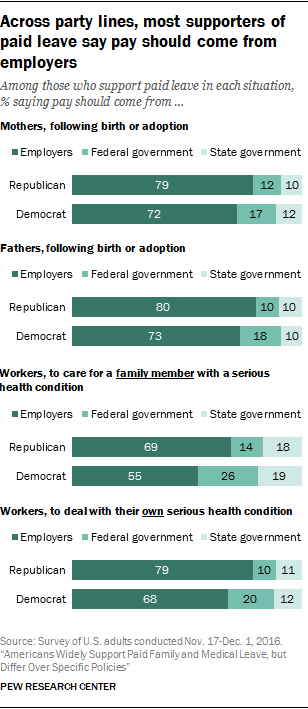 About 3-quarters of Americans who support paid go out for mothers (74%) or fathers (76%) following the nascency or adoption of a child say pay for fourth dimension off should come from employers, and a like share (72%) of those who favor paid medical leave for workers with a serious health condition say the same. When it comes to who should embrace the price of paid get out for workers when they have fourth dimension off to intendance for a family member with a serious health condition, a smaller majority (59%) of paid-leave supporters say pay should come up from employers, while about two-in-10 say information technology should come from federal (22%) or land (xx%) government.
The majority of paid-get out supporters beyond the political spectrum are more likely to await to employers rather than to authorities to cover the costs of providing this benefit, although Democrats express more support for authorities-paid family and medical exit than do Republicans. For example, about a 3rd (32%) of Democrats who say workers should take paid go out from work to bargain with their own serious health condition say pay should come from either the federal or state government, compared with 21% of Republican supporters of paid medical leave. And while 45% of Democrats who support paid get out for workers who take fourth dimension off to intendance for a seriously ill family unit member say the government should pay for this benefit, 31% of Republicans who back up paid exit for this reason say the same. More than modest but even so significant partisan differences are also evident on views of who should pay when mothers and fathers take exit.
 Overall, Democrats are more supportive of paid leave than are Republicans and independents, though at least iii-quarters of each group say mothers should have access to paid maternity leave and that workers should be able to take paid leave to deal with their own serious wellness status. Democrats, Republicans and independents are less supportive of paid get out for fathers and for workers who need to care for a family fellow member with a serious health condition than they are of paid maternity and medical go out. Still, nearly Democrats and independents – and simply over half of Republicans – limited support for paid leave in each of these two situations.
Women and young adults also mostly limited more than back up for paid leave than do men and those ages thirty and older. For example, 82% of adults ages 18 to 29 say fathers should exist able to have paid leave following the birth or adoption of their child, compared with 76% of those ages 30 to 49, 61% of those l to 64, and 55% of adults 65 and older.
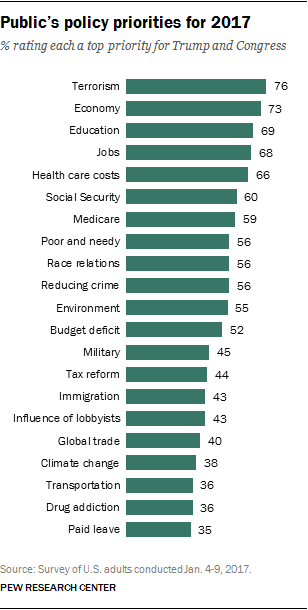
Despite the broad support for paid leave, a Pew Research Eye survey conducted January. four-9, 2017, about the public's policy priorities for President Donald Trump and Congress in the coming year finds that relatively few Americans (35%) run into expanding access to paid family and medical leave as a tiptop policy priority. In fact, expanding admission to paid family and medical get out ranks at the lesser of a list of 21 policy items, along with improving transportation and dealing with drug addiction.
Near see at to the lowest degree some benefits for employers that provide paid go out
While Americans tend to favor employer-paid over government-paid leave for family or medical reasons, in that location is no consensus when it comes to a federal government mandate: About as many say the authorities should require employers to provide paid exit (51%) equally say employers should be able to decide for themselves (48%). Opposition to a federal mandate is highest amid those who oppose paid get out; among those who support paid family or medical leave, including those who say employers should pay, more say the authorities should require employers to offer this benefit than say it should be the employers' determination.
Still, regardless of whether they support a federal government mandate, most Americans retrieve employers stand to benefit from providing paid family and medical exit. About three-quarters (74%) of the public says employers that provide paid leave are more than likely than those that don't to attract and keep good workers; 78% of those who favor a authorities mandate and 70% of those who say employers should decide for themselves share this view.
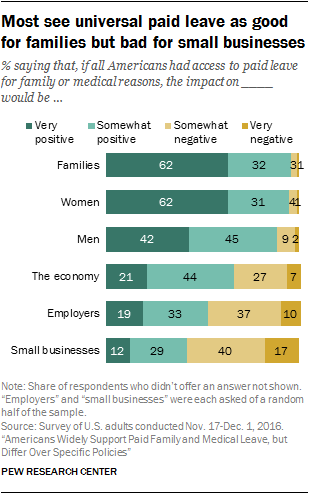 Assessments of the overall impact of paid family and medical go out on employers are more than mixed: 53% say universal access to paid go out would take a positive impact on employers, while 46% say the overall impact would be negative. When asked specifically nigh the impact on small businesses, the residuum of stance is incomparably negative. Roughly 6-in-x Americans (58%) say that universal access to paid exit would have a very or somewhat negative impact on small businesses, while 41% think the impact would be generally positive. Past comparison, in that location is significant consensus effectually the potential benefits to women and families, with nigh six-in-ten Americans expecting "very positive" results. Overall, nigh ii-thirds or more than say the bear upon of universal paid exit on families (94%), women (93%), men (88%) and the economy (65%) would be at least somewhat positive.
The public also makes a distinction between employers in general and pocket-size businesses in assessments of the trade-offs they may need to make in order to provide paid family and medical leave. About vi-in-x (59%) say nearly employers that provide paid leave can afford to practice then without reducing salaries or other benefits. In contrast, a majority (69%) say virtually small businesses that offer paid get out accept to cutting dorsum on salaries and other benefits in social club to do so.
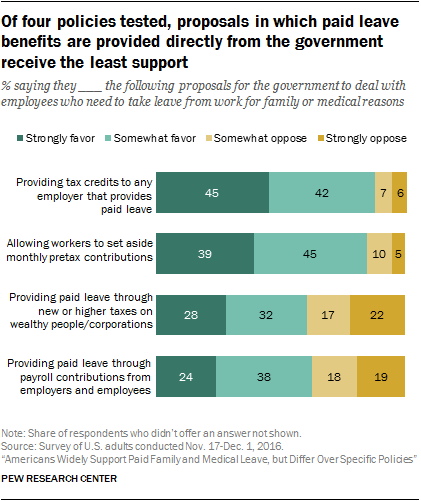 There's no public consensus on the best policy arroyo for providing paid family and medical leave. In general, the public has a more than positive view of policies that incentivize employers or employees rather than those that create a new government fund to finance and administer the benefit.
Some 45% of Americans say they would strongly favor the regime providing taxation credits to whatsoever employer that provides paid get out. And roughly four-in-ten (39%) express strong support for assuasive workers to prepare aside monthly pretax contributions into a personal business relationship that can be withdrawn if they need to take leave from piece of work.
There is less back up for a program where the government would provide paid leave to any worker who needs it using funding from new or higher taxes on wealthy people or corporations – 28% strongly favor this approach. Similarly, 24% strongly favor the establishment of a government fund for all employers and employees to pay into through payroll contributions that would provide paid leave to whatever worker who needed it.
Support for new regime programs that would provide paid family unit and medical leave to all workers that demand it is far stronger among Democrats than amongst Republicans or independents. Some 44% of Democrats say they would strongly back up a government paid get out program funded by new or higher taxes on wealthy people or corporations, compared with about a quarter (24%) of independents and just eleven% of Republicans. And while virtually a third (34%) of Democrats express strong support for a government paid leave fund that all employers and employees would pay into through payroll contributions, smaller shares of independents (20%) and of Republicans (15%) say they would strongly favor this approach.
Democrats are also more probable than Republicans or independents to say they would strongly support the government providing tax credits to employers that provide paid family unit and medical leave: Near one-half (53%) of Democrats express strong support for this approach, compared with about four-in-x Republicans (37%) and independents (41%).
The vast majority of Americans (85%) say that, if the government were to provide paid family unit and medical go out, the benefit should be available to all workers, regardless of their income, rather than beingness more narrowly targeted to those with low incomes. When information technology comes to paid parental exit specifically, about three-quarters (73%) believe that if the government were to provide this benefit, it should be available to both mothers and fathers.
 About seven-in-x fathers who have paternity leave return to work within two weeks
Most Americans (63%) believe that mothers generally desire to take more than time off from work than fathers after the nascency or adoption of their child, and more than say employers put greater pressure level on fathers to return to work rapidly (49%) than say mothers face more pressure level (18%) or that both confront nearly the same amount of pressure (33%) from employers.
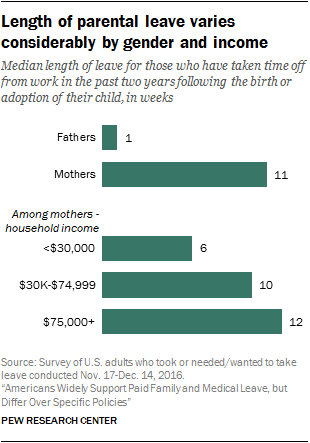
The survey of adults who took leave or who needed or wanted to take leave but weren't able to do then finds that among fathers who took at to the lowest degree some time off from piece of work post-obit the nascence or adoption of their child in the by 2 years, the median length of go out was one calendar week; almost seven-in-ten (72%) say they took two weeks or less off from piece of work. In contrast, the median length of maternity leave was xi weeks. Among mothers with household incomes under $30,000, still, the median length of leave was six weeks, compared with ten weeks for those with incomes between $30,000 and $74,999 and 12 weeks for mothers with household incomes of $75,000 or more.
For the well-nigh part, mothers and fathers who took parental leave in the past 2 years say taking fourth dimension off did not have much of an touch – either positive or negative – on their task or career; 60% say this is the case. Still, women are about twice as likely as men to say taking fourth dimension off following the birth or adoption of their child had a negative impact (25% vs. xiii%, respectively).
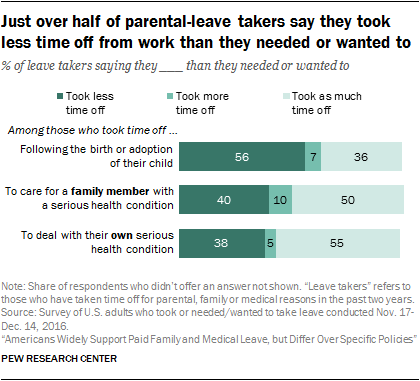 Only over one-half (56%) of parental-leave takers say they took less time off from work following the birth or adoption of their child than they needed or wanted to, while 7% say they took more time off and 36% say they took about every bit much time off as they needed or wanted to. Some 59% of fathers and 53% of mothers say they wish they had taken more time off from work than they did following the birth or adoption of their child.
Smaller merely substantial shares of those who took time off from work to care for a family member with a serious wellness status or to deal with their own health result likewise say they took less time off from work than they needed or wanted to take (40% and 38%, respectively).
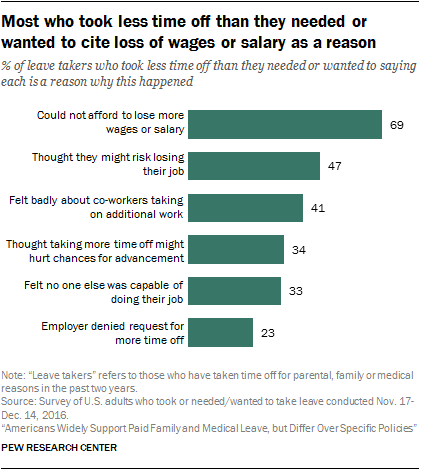 Fiscal concerns superlative the listing of reasons why those who took get out for parental, family or medical reasons say they took less time off than they needed or wanted to. Nigh seven-in-x (69%) leave takers who returned to work more chop-chop than they would have liked to say they couldn't afford to lose more wages or salary. Virtually one-half (47%) say they thought they might run a risk losing their job, while 41% say they felt badly nigh co-workers taking on additional piece of work. Nearly a third idea taking more time off might hurt their chances for chore advancement (34%) or felt that no one else was capable of doing their job (33%). And most a quarter (23%) of those who took less fourth dimension off than they had needed or wanted to say their employer denied their request for more time off.
Many leave takers accept on debt or use savings in order to cover lost wages
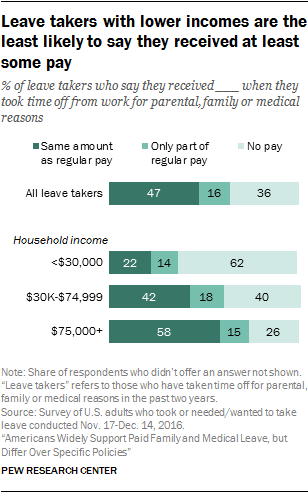
Almost Americans who took fourth dimension off from work in the by ii years for parental, family or medical reasons study that they received at to the lowest degree some pay during this time, with most half (47%) proverb they received total pay; xvi% say they received only some of their regular pay and 36% say they received no pay at all. Lower-income leave takers, as well as those without a bachelor's degree, are especially probable to say they received simply some or no pay. For example, among leave takers with household incomes of $75,000 or more than, roughly six-in-x (58%) say they received the same corporeality as their regular pay, while fifteen% received partial pay and about a quarter (26%) were not paid. In contrast, but 22% of those with incomes nether $thirty,000 report that they received full pay, while xiv% received only some of their regular pay and a majority (62%) received no pay during their time off from work.
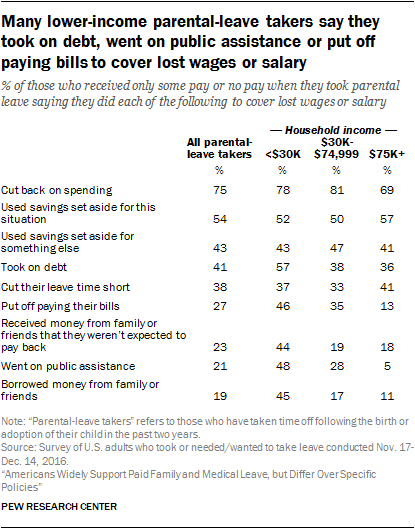 Leave takers who did not receive their full wages or salary when they took parental, family or medical leave say they had to make sacrifices, such as cutting back on spending, dipping into savings, or cut their leave short, to recoup for the loss of income. Some, peculiarly those with lower incomes, took more consequential measures, such as taking on debt, putting off paying their bills, and going on public aid.
Roughly half-dozen-in-ten (57%) parental-leave takers with household incomes under $30,000 who did not receive their full pay when they took time off from piece of work following the birth or adoption of their child say they took on debt to deal with the loss of wages or salary; almost half say they went on public assistance (48%) or put off paying their bills (46%).
Views of gender and caregiving are related to back up for paid leave for new fathers
While almost Americans are supportive of mothers and fathers taking leave from work – and receiving pay – following the nativity or adoption of a child, many see mothers, and women in general, equally more apt caregivers. The survey finds that a majority (71%) of Americans think it's of import for new babies to have equal time to bail with their mothers and their fathers, while about a quarter (27%) think it'due south more important to bond with their mothers and merely 2% say it's more important for them to bond with their fathers. But when it comes to caring for a new babe, more than say that, aside from breast-feeding, mothers do a better task than say both mothers and fathers do nearly an equally skillful task (53% vs. 45%); but one% say fathers do a improve job than mothers in caring for a new babe.
The public offers more gender-balanced views when asked who would do a better task caring for a family fellow member with serious wellness status – 59% say men and women would do an equally good job. Still, four-in-ten say women would do a ameliorate job in this situation (ane% say men would).
Older adults and Republicans – particularly those who describe their political views as conservative – are specially likely to say that information technology's more than important for new babies to have more time to bail with their mothers than with their fathers and that mothers practise a amend chore caring for a new babe.
Attitudes virtually gender roles and caregiving are linked, at to the lowest degree in function, to views about the impact of paid leave on men, as well as to support for paid paternity get out. Generally, adults with more gender-counterbalanced views well-nigh mothers and fathers equally caregivers for new babies are far more supportive of paid paternity leave than are those who say mothers are better caregivers. Those with more gender-counterbalanced views are likewise more likely to say universal paid leave would have a very positive impact on men.
For example, among those who say mothers and fathers do about an every bit adept task caring for a new baby, 78% express back up for paid paternity leave and one-half say universal paid leave would have a very positive impact on men. Past comparison, among adults who say mothers exercise a meliorate job, these shares are 61% and 37%, respectively. Significant differences remain when controlling for factors such as gender, age and political ideology, which are associated with support of paid get out for fathers and the impact of universal paid leave on men in general every bit well equally with attitudes near gender and caregiving.
The remainder of this report examines in greater detail the public's views virtually paid leave as well as the experiences of workers who accept taken parental, family unit or medical go out in the past two years. Capacity one-4 focus on findings from the survey of the general public. Affiliate 1 looks at the public's evaluations of different paid leave policies, including who Americans think should be covered also as who should pay. Chapter 2 explores assessments of the touch of paid leave on families, the economy, employers and employees. Chapter three looks at workers' assessments of the benefits they receive from their employers and how family unit and medical leave fits in to the broader benefits landscape. Chapter 4 explores views of gender and caregiving.
Chapter 5 examines the experiences of those who took leave and those who weren't able to take leave when they needed or wanted to do so. It looks at whether or not those who were able to accept leave received any pay during this fourth dimension and how they coped with the loss of income if they did not receive full pay. It also explores reasons why some people return to piece of work sooner than they wish to after taking parental, family or medical go out, and why some aren't able to take time off from piece of work at all when they demand or desire to do so. Finally, Chapter 6 provides some quotes from eight focus groups of recent parental- and family-leave takers to illustrate the diverse and circuitous experiences of leave takers.
Other central findings
- Americans limited some concern that paid family and medical get out benefits can be abused. Some 55% think it is at to the lowest degree somewhat common for workers who have admission to this benefit to abuse it by taking fourth dimension off from piece of work when they don't need to; 44% say this isn't particularly common.
- Most workers are at to the lowest degree somewhat satisfied with the benefits their employer provides (69%) and believe their employer cares a nifty bargain or a fair amount about the personal well-being of their employees (66%). These assessments vary considerably past income, however; only near one-half of workers with household incomes under $30,000 express some satisfaction with their benefits and say their employer cares about their employees' well-existence, compared with majorities of those with college incomes.
- Three-in-10 get out takers say it was difficult for them to acquire about what get out benefits, if any, were available to them when they needed to have time off from piece of work for parental, family or medical reasons, and this is peculiarly the case amid those with a loftier schoolhouse diploma or less and with lower incomes. Leave takers with lower incomes and those without a bachelor'southward degree are also less likely to say their supervisor and co-workers were very supportive when they took leave from piece of work.
- Among those who took time off from work to care for a family fellow member with a serious health status in the past two years, women (65%) are far more likely than men (44%) to say they were the master caregiver. Family-leave takers ages 65 and older were more probable than those who are younger to say they were caring for their spouse or partner during this time, while those ages 50 to 64 were particularly likely to be caring for one of their parents.
Throughout this study, when referring to attitudes toward paid exit policies, the terms "family and medical go out" and "taking time off from work for family unit or medical reasons" refer to taking time off following the birth or adoption of one's child, to care for a family fellow member with a serious health status, or to deal with 1's ain serious health condition. In order to distinguish between the experiences of those who took time off from work (or who needed or wanted to take time off but weren't able to exercise then), the term "parental leave" refers specifically to time taken off from piece of work post-obit the birth or adoption of one's child; "family leave" refers to taking at least five days off from work to care for a family unit member with a serious health condition; and "medical leave" refers to taking at least five days off from work to deal with one's own serious health condition.
"Leave takers" refers to those who were employed in the past 2 years and took time off from work during this time post-obit the birth or adoption of their child, to care for a family member with a serious wellness condition, or to deal with their ain serious health condition. "Paid get out" refers specifically to paid leave for parental, family or medical reasons.
References to whites and blacks include merely those who are non-Hispanic and identify every bit merely 1 race. Hispanics are of any race.
References to higher graduates or people with a higher degree comprise those with a bachelor'southward degree or more. "Some higher" refers to those with a two-yr degree or those who attended higher but did not obtain a degree. "High school" refers to those who take attained a high school diploma or its equivalent, such as a General Education Development (GED) certificate.
baumgartdereddeedly.blogspot.com
Source: https://www.pewresearch.org/social-trends/2017/03/23/americans-widely-support-paid-family-and-medical-leave-but-differ-over-specific-policies/

Postar um comentário for "How Many Weeks Is Ny Family Paid Leave"